


So much has already been said and written about Marina Herlop’s new album, Dja Dja. So much praising - rightly so - of a monumental work and its creator that adding anything else might feel repetitive, if not entirely superfluous. The only contribution I could possibly make, then, is to offer a privileged perspective in every sense: a glimpse behind the scenes of the album, from its inception to its troubled development. A perspective made possible by the fact that — and in the interest of full transparency, this needs to be clarified — I have been close friends with Marina Hernandez Lopez for several years now: Herlop, the shortened form of her double surname.
“Me? Oh, I’m incredibly happy right now”, says the Catalan pianist and singer backstage at the Łaźnia Nowa Theatre in Kraków, Poland. She is still wearing the stiff leather corset and chainmail skirt she had on just minutes earlier on stage at “Unsound Festival”. It is 9 October, release day, and Marina has just wrapped up the first proper date of the tour to roaring applause. Technically, there had been a show the night before in Vienna, but it was hampered by technical issues that had nothing to do with the performance itself. Herlop, meticulous by nature, had endured them with quiet resignation: they were entirely unforeseeable, and there was nothing she or anyone on her team could have done to prevent or resolve them.
“I get the feeling that people are listening to and appreciating this album with a great deal of care, exactly the same care that went into making it”. You don’t need an especially keen ear to hear it: Marina Herlop’s fifth album is by far the most painstaking, ambitious and, consequently, risky work of her career. It was like taking an enormous leap into the void, with the fall — and the uncertainty surrounding the landing — stretching into a two-year-long eternity.
Every listen reveals new details, the album unfolding as a single continuous body of work divided into 15 movements. Things that previously went unnoticed emerge, not because the listener — whom she calls the receptor in Spanish, despite our conversations being in English — wasn’t paying attention, but rather because of the remitente’s skill in directing the ear through lush, ever-shifting geometric labyrinths, in a pointillist interplay of harmonised voices, counterpoint and drops of synthesiser. Shy and hard on herself as she is, she would never speak of such skill, of course. Instead, she prefers to blend into the luxuriant vegetation of her fantasy landscapes, or she’d risk becoming too visible. “Basically, musicians are listeners too, right? So we’re all receptores of music”.
I know that her favourite composers, without question, are Debussy and Ravel. Yet never before Dja Dja had Marina taken on the responsibility — driven by an urgency that could no longer be postponed — of giving tangible form to her love of the deceptively simple complexity of classical music, and Impressionism in particular (a term Debussy himself consistently rejected, incidentally). The first thing that came to mind, by way of analogy, when I listened to the album master one day in early September, while summer was still in full swing in Milan, was Isao Tomita’s Snowflakes Are Dancing: a cult classic of 1970s avant-garde music, reimagining Debussy’s best-known tone paintings using nothing but a Moog synthesiser and a Mellotron.
“I love that record!”, she tells me with a smile. “The other day, ‘Pitchfork’ asked me to name an album I’d give a 10/10, and I said Snowflakes Are Dancing!”. What she didn’t tell ‘Pitchfork’ is that she and a close friend — who also helped her with some of the arrangements on Dja Dja — have a dedicated WhatsApp chat in which he plays Tomita, replying from heaven in a slightly bored manner as she asks him important existential questions. Then again, playfulness is fundamental to Marina: she is one of the funniest people I have ever met. I don’t know how many bodies her soul inhabited before being born into its current one in 1992, but given her innate comic timing, one of her previous incarnations must surely have belonged to a sailor, or anyone of those classic figures from European folk culture, quick-eyed and always ready with a punchline.
In any case, whereas the colour palettes of Nekkuja (2023) and its predecessor Pripyat (2022) leaned towards darker tones, Dja Dja marks a radical shift in direction. Here, escapism from the cold shower of reality edges into mythology and epic adventure, spawning landscapes like lines of code in a video game populated by fairies and all sorts of magical creatures. All around them, the birdsong in ツラ (sampled from Jean-Claude Roché’s Birds of Venezuela, as Björk had already done on Utopia) and the sea mists dancing across the waters of Thálassa! are devices in the construction of an entire world. And in that world, whether she likes it or not, Marina is the heroine tasked with completing the twelve labours of Hercules (fifteen, in this case, if we go by the tracklist). Herlop is still getting used to this duality: the craftswoman who spends two years “sitting in the studio, at the computer, like a stone gargoyle” and the adventurer “sort of like Aragorn in The Lord of the Rings”, then roaming vast territories on tour. And who could blame her? “One day you’re at home in your pyjamas, completely unaware of what’s going to happen, and the next you find yourself on stage wearing lipstick”, she jokes, still wearing it.
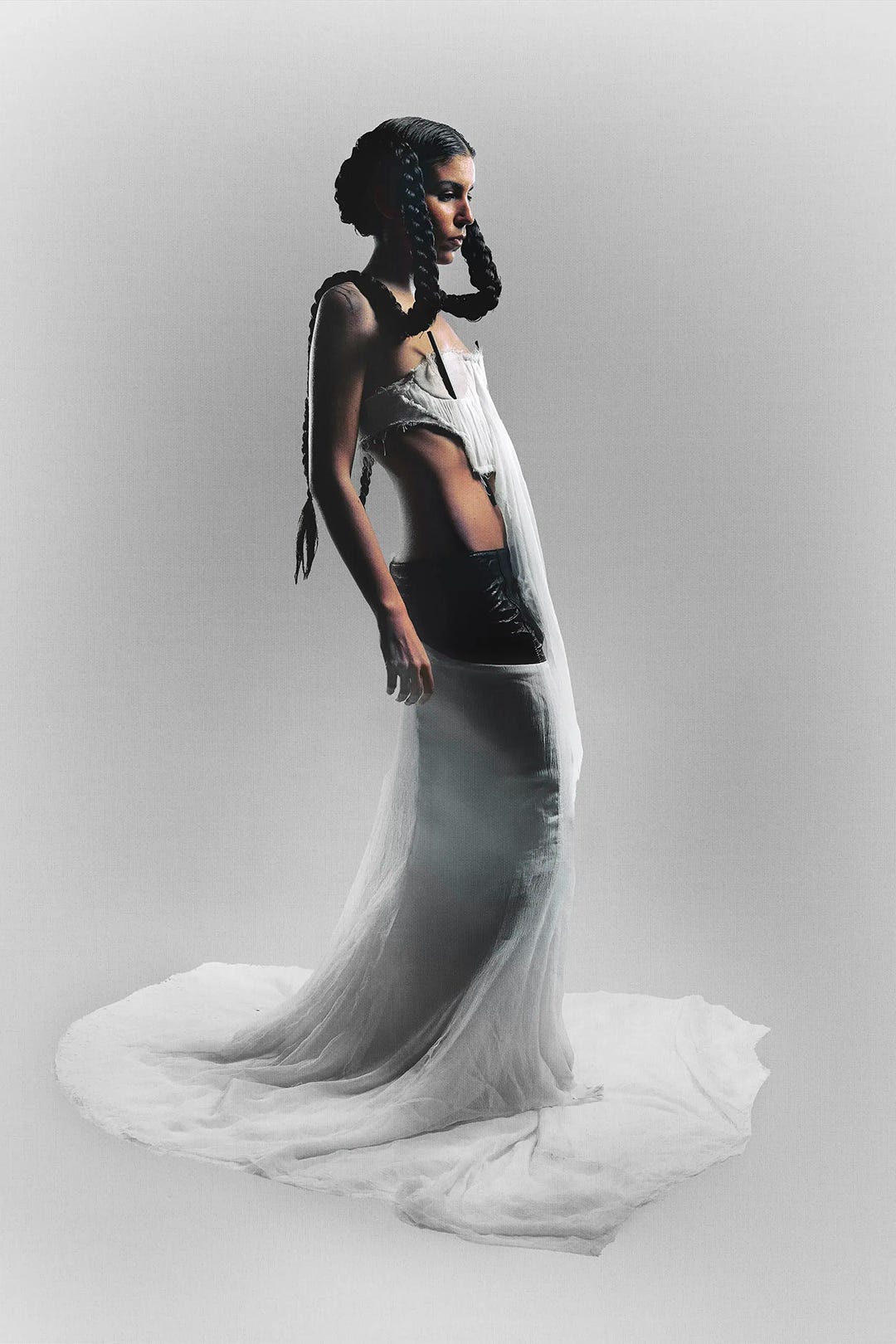
Much like Isao Tomita, who came close to bankruptcy to get his hands on a $200,000 Moog III, with no idea of what would become of his modular-synthesiser reworking of Debussy, Marina too embarked on a seemingly hopeless mission completely blind. She didn’t even have a record label in mind to pitch the album to, eventually opting — another decision worthy of praise — to release it independently. The only lantern illuminating a path paved with existential Weltschmerz was that stubborn creative urgency that torments true artists, while sparing tradespeople and the masters of marketing, social media engagement and views. “The more music I make, the more I feel this incompatibility between the speed of creation and the pace of the world we live in now, of everyday life, which, as you know, can sometimes be difficult to bear given the sheer number of stimuli we’re exposed to”, she tells me, completely barefoot. The heeled shoes she wears on stage are beautiful but uncomfortable, and she is certainly not used to wearing them for an hour, most of which she spends standing. Because yes, this is an album made to be performed and danced to live. “So I made sure to protect it from ‘real life’, even though I’m not entirely sure what that is. As if the album were a spoiled child, with a mother who gave it everything it asked for: time, care. Of course, the day eventually comes — today, in this case — when you have to let the record go and share it with the world. But some things take time to create, just as it takes time to become friends with someone or to build a relationship. Love develops slowly. And that’s precisely how, I don’t know, a fossil forms, or nature truly reveals itself. We live in such a fast-paced world, convinced that everything should happen quickly. But there are things you simply cannot speed up. Creation is one of them”.